
Rechargeable Batteries: A Modern Energy Solution
As a product of the 60’s I envision a singing battery sitting on the steps of Congress singing a song about Lithium and other rare earth materials a ‘la School House Rock style. One working title might be, “I Love Your Flattery But We Can’t Be Together Because I’m A Rechargeable Battery.”
Or, “Lithium, I Hardly Knew Him”
Hence “The More You Know” graphic.
When i start studying a subject I really dig in. The last week or so of my life has been all about batteries. I have some background in this as I was a Corrosion Control Instructor for DoD (now DoW) for many years. Corrosion is an electro-chemical reaction that produces a voltage when two dissimilar metals meet in the presence of an electrolyte. The further apart the two metals are on the Galvanic Series chart, the more voltage that is produced.
Now I’m but a mere blogger but every year about this time I have a manufacturer or two that ask me to test and review batteries. This year is no different.
But this year I dug in a little deeper and even bought some new test equipment which I hope to showcase here.
What Do You Know About Batteries?
Most of us don’t know a lot. Just that we need to keep some around the house for toys and radios and flashlights and remote controls. When they die we throw them away and go buy more. In this day and age where everything gets purchased online we have a tendency to buy the cheapest things available and this certainly extends to batteries. They never were super cheap but the cost of good batteries now is kind of appreciable.
But is buying cheap the best approach? Before we do that let’s examine some common batteries
Size Matters
Most of us know batteries by their size designations. And for a lot of us that doesn’t extend beyond AAA and AA sized cells. Back when I was a pup we had A,B, C, and D. These days we kind of mostly have drifted towards:
- AA or AAA
- C or D
- Sub C – This is a common battery you’ve never heard of.
- 9 Volt
- 123A
- 18650 – Common for flashlights
- 21700 – Common for really bright flashlights
Battery Testing
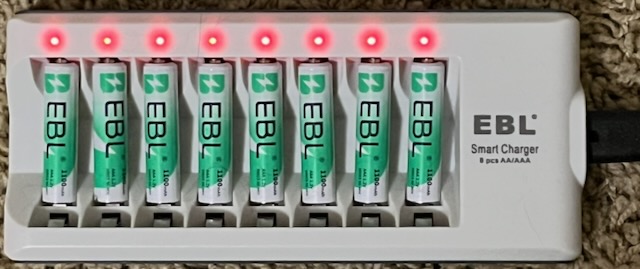
When you buy a handful of batteries from somewhere you usually get a free charger that gives you a red light, green light indication. Helpful, but it provides no useful battery health information at all.
By the way, I reviewed the batteries above and they are inexpensive AND they met or exceeded their own claims for AA rechargeable batteries.
Here is a short list of battery parameters that should be checked if you suspect a degraded or bad cell.
- Voltage
- Current
- Internal Resistance
- Capacity
Voltage
We can measure voltage with a simple DC voltmeter. And of course even some battery testers may display voltage. A NiMH battery has a nominal voltage of 1.2v. A Lithium-Ion AA or AAA battery has a nominal voltage of 1.5v. Larger cells like the 18650 and 21700 are rated at 3.7v.
The lower voltage in a NiMH battery may be detrimental when using in a high drain device such as a camera or powerful flashlight. NiMH batteries are inherently safer and work better in cold environments. A Lithium-Ion battery generally requires a protection circuit so they don’t overheat and become damaged.
As far as cost goes, Lithium-Ion batteries are typically more expensive.
Current
The relationship between batteries and current relates to the discharge, and subsequent charging actions. This is an oversimplification, but most test equipment for cylindrical, household type batteries allow for charging around 2.0 Amps and if all battery slots are full it reduces to 1 Amp.
Internal Resistance
Batteries should have a reasonably low Internal Resistance. Ohms Law says that the more resistance present the higher the voltage drop realized.
Unlike a voltage measurement you cannot simply use a multi-meter. Well, technically you can however a two wire test will be wildly inaccurate. These measurements are very small in nature and by using the 2 wire method you end up also testing the resistance of the meter wires and contact points or probes.
4 Wire Test
A 4 wire, or Kelvin Connection test, eliminates the limitations of the two wire test. The results are in milli ohms (m Ω).
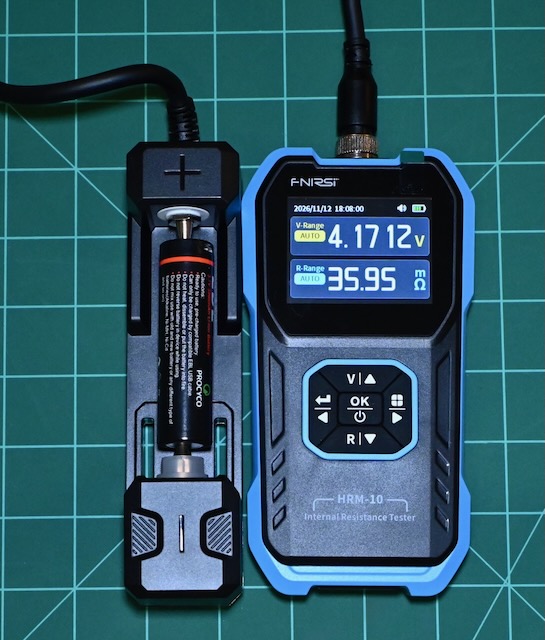
This is a common, and inexpensive tester from FNIRSI called the HRM-10.
The model depicted in the photo is the HRM-10 Plus. The plus has the fancy battery holder. I called it fancy but the truth is, it is the only way to fly, as they say.
The top measurement is battery voltage, and the lower measurement is the internal resistance.
The manufacturer of whatever battery you are testing should provide info on what a healthy internal resistance number is. There is no “one and done” chart out there.
While it won’t test capacity, it provides the tester with some quick “keep or toss” data. A battery with a high internal resistance as per the manufacturer’s recommendation should simply be tossed or dropped in the emergency use only box.
Capacity
On the battery label the capacity is required to be listed. It will either be in milli amp hours (mAh) or milli watt hours (mWh). You are in for a shock with what I’m about to tell you.
A LOT OF MANUFACTURERS LIE AND PROVIDED DECEPTIVE, AND INFLATED CAPACITY NUMBERS..
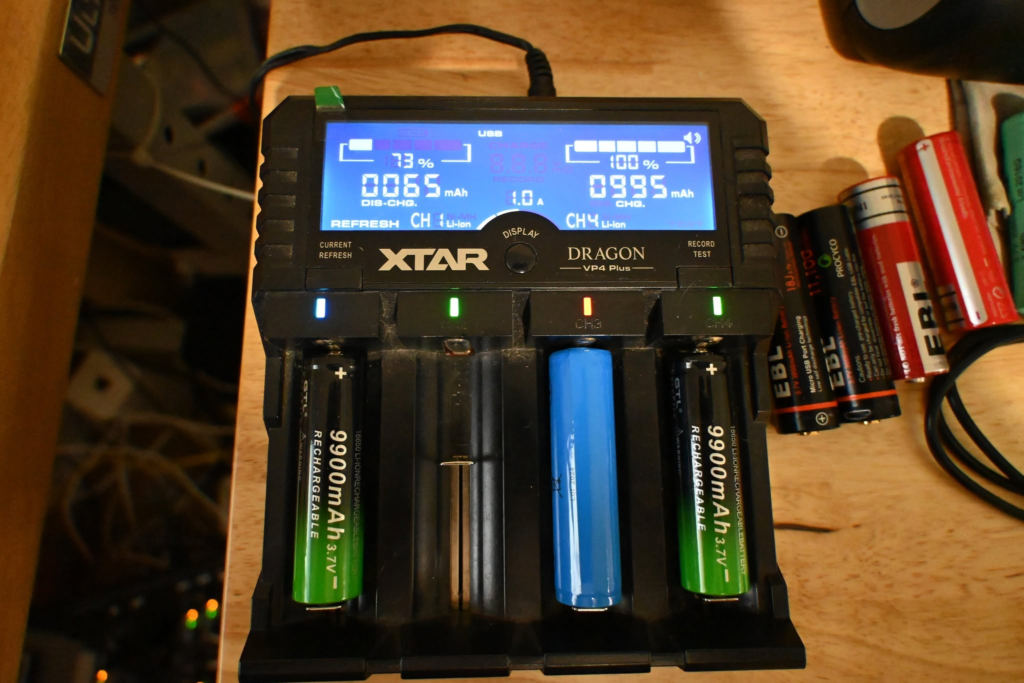
Look at the battery on the far right and the data displayed about it. After a full discharge n my XTAR VP4 Plus and subsequent recharge the battery indicates a full charge of 995 mAh.
Look at the claim on the label though. 9900 mAh. Just a tiny bit inflated, eh? I can tell you for a fact without testing that the capacity claims of this battery are lies. How? Because no 18650 battery out there on planet earth has a capacity much higher than 3500 mAh.
The companies branding is GFL Surefire. Don’t buy GFL Surefire batteries.
To convert milliwatt hours to milli amp hours you simply take the advertised mWh number and divide it by the voltage of the cell. Check out the photo of the battery below.
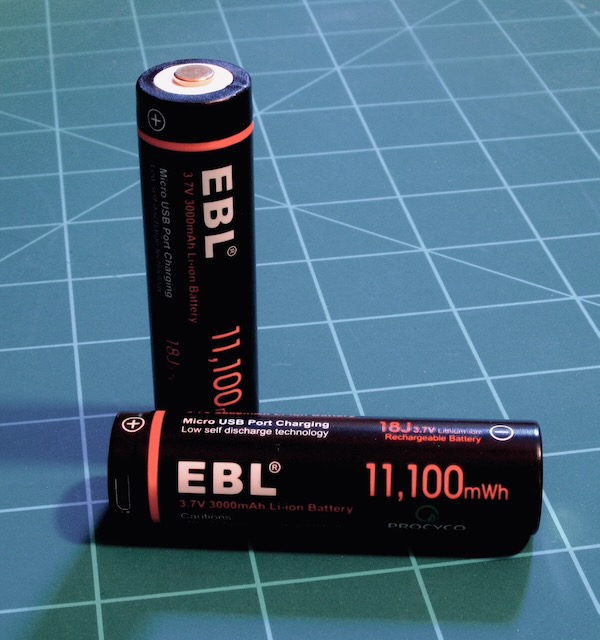
The capacity is listed as 11,100 mWh. And the cell voltage is 3.7v
11,100➗3.7= 3000 mAh
That is NOT an outrageous claim and the batteries test close to that claim.
I would not call this deceptive at all like I blatantly did with the GFL batteries above.
Additional Test Equipment
Let’s start with the XTAR VP4 Plus that I depicted above. What you see on the screen is a percentage of battery charge and the mAh number. The VP4 Plus will test voltage and internal resistance but the user must plug in the Kelvin probes and manually test the batteries.
For users like me and you who are probably testing a handful of batteries or less this is perfectly acceptable. Finding a way to hold the batteries is recommended because picture yourself trying to hold two probes, one on each end of a small round battery and possible push a button or something. Hilarity ensues.
My Favorite Tester So Far
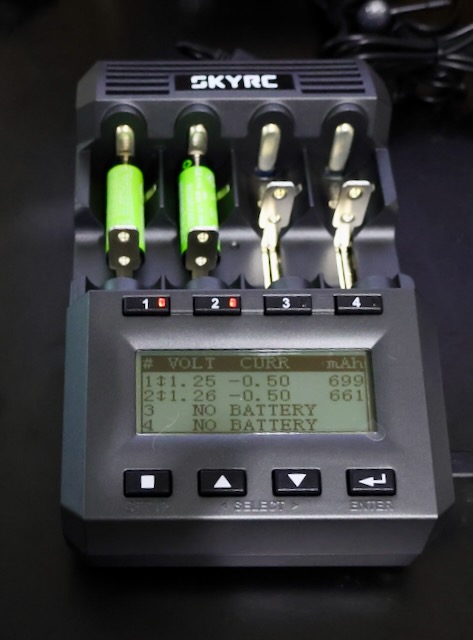
A company called SkyRC made a tester with the designation of MC3000.
Although the SkyRC MC3000 remains an actively supported product, its availability through US retailers appears somewhat limited. Several established battery and RC equipment retailers currently list it as out of stock, while a smaller number continue to advertise available inventory. The MC3000 may still be in production, but it is not as readily available through US distribution as one might expect for a current product.
I found mine on eBay as new old stock (NOS). Still happily wrapped in plastic.
The desktop software for this thing is Windows only (Boo). But there is a very useful IOS or Android App called MC3000. A GitHub user made a website that allows for serial connection of the device to a Chrome based browser and the user can modify testing parameters and control testing from a USB connected MC3000. It is pretty incredible.
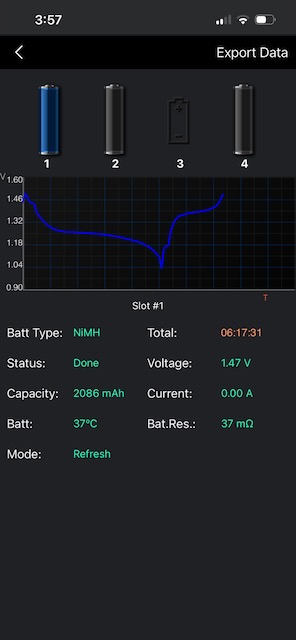
The IOS app screenshot here shows a voltage discharge and charge curve and the app also displays
- Battery Type
- Status
- Capacity
- Temp
- Mode
- Total Time
- Voltage
- Current (if charging or discharging)
- Battery Internal resistance
Essentially, my entire list above is done on this one machine.
What’s the catch, Doc?
To perform some deep battery analysis you should run a Refresh Cycle (Charge>Discharge>Charge) and it takes HOURS AND HOURS.
Will it just charge a battery if you want it to? Yep it will, and quickly, but this is what you use when you find some old expensive batteries that have been lost in the back of the junk drawer for ages.
I put some double AA batteries on the tester last night at 10 PM and as I type this at 5 AM the next morning only 2 of them are done so far. Patience, grasshopper.
ZKETech EBC-A20
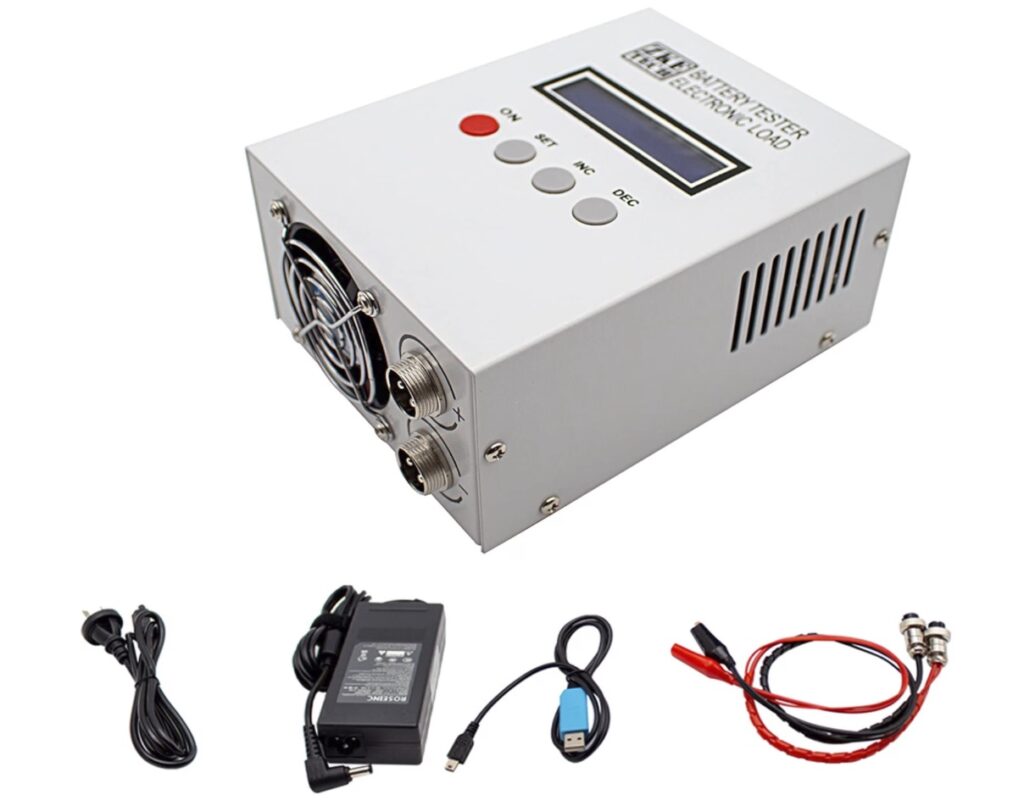
Another advanced tester that I haven’t gotten my hands on yet, but is inbound. More later.
This is sold under a lot of different brand names. Get one from ZKETech if you can. The product is the same but manuals, and firmware and such can be different.
It is a four wire tester and does a lot for its very affordable cost.
Which One Is Right For You?
If you are a casual battery user the old red light, green light chargers are probably working for you. However, over the course of years I bet you’ll spend a lot more money on batteries than I will. Instead of your little battery powered radio that you listen to when doing some task outside working for a week without charging the batteries maybe it now only works for a day or less.
You’ll toss that battery. I’ll discharge it to cutoff voltage and recharge it and possibly even run it through that cycle 2-3 times and GET A LOT MORE USE OUT OF IT. Maybe.
While I love my SkyRC MC3000 I recommend the charger / testers from XTAR. I’ve been using my Dragon XTAR VP4 Plus for years. I just gifted it to my nephew because I replaced it with the XTAR VP4L (L=Longer, as in lengthier battery slot). I have several 21700 batteries with are 70+ mm long and things are trending in that direction.
Red Light, Green light is no way to live, Soldier.