
Why I Use a Dedicated Four-Wire Internal Battery Resistance Tester — And Why You Should Too
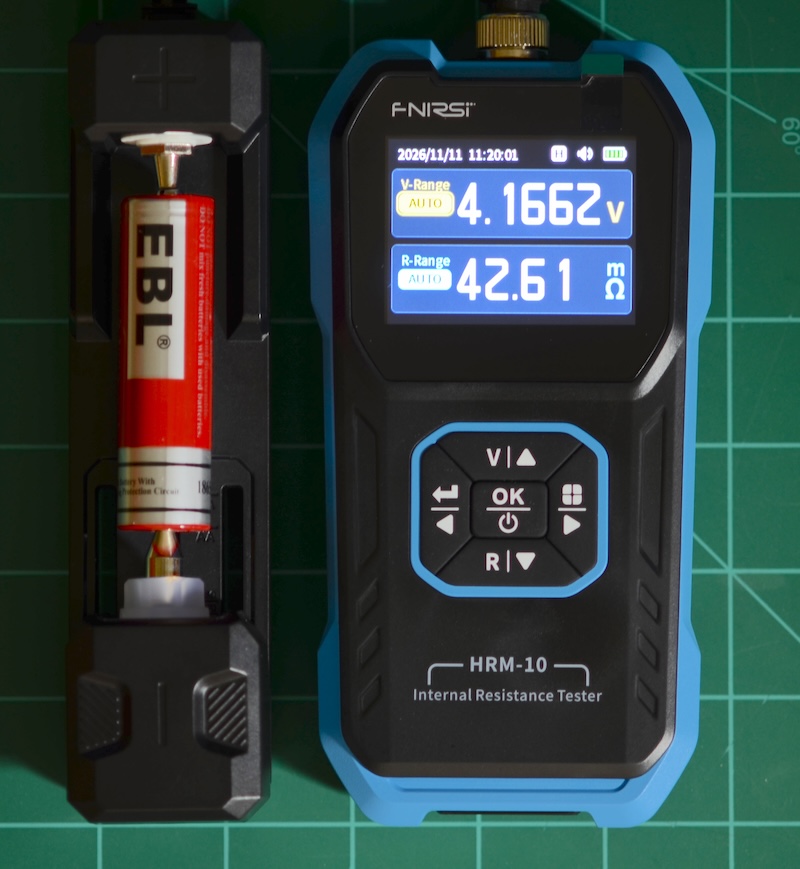
Question: How many of you own items that use batteries? Looks like the response is “Everyone.” Now, how many of you use rechargeable batteries? Fewer, certainly, but still a decent amount. What if I told you that many of the rechargeable batteries out there don’t even come close to their advertised capacity or internal resistance claims?
The battery in the picture is testing fine, but if the battery you bought at the store or online wasn’t, you would probably never know it—other than noticing it performs poorly or dies early. If you are a casual consumer and not a tech hardware geek, you may not need a dedicated tester.
Conversely, you should definitely hop on the internet and research which battery brands actually perform as advertised. However, I do think everyone needs some type of basic battery tester. And for us geeks, you need a reliable way of verifying manufacturer claims.
Why Measuring Battery Internal Resistance Matters
Ohm’s Law, Baby!
The higher the internal resistance, the lower the usable voltage under load. Additionally, a highly resistive battery produces excess heat. Ever touched a hot battery before? Here is a real-world example of how a highly resistive battery (such as an 18650 lithium-ion cell) behaves under a 1.0 Ω load compared to a healthy one:
Comparison: Healthy vs. Highly Resistive 3.7 V Battery
| Metric | Healthy Lithium Cell (r = 0.05 Ω) | Highly Resistive Cell (r = 2.0 Ω) |
|---|---|---|
| Open-Circuit Voltage (E) (Measured with no load) | 3.70 V | 3.70 V |
| Total Circuit Current (I) I = E / (R + r) | 3.7 / (1.0 + 0.05) = 3.52 A | 3.7 / (1.0 + 2.0) = 1.23 A |
| Internal Voltage Drop (I × r) (Voltage lost inside the battery) | 3.52 × 0.05 = 0.18 V | 1.23 × 2.0 = 2.46 V |
| Usable Terminal Voltage (Vterminal) Vterminal = E – (I × r) | 3.7 – 0.18 = 3.52 V | 3.7 – 2.46 = 1.24 V |
| Power Delivered to Load (I² × R) | 12.4 Watts (Bright light) | 1.5 Watts (Dim or non-functional) |
| Wasted Internal Heat (I² × r) | 0.62 Watts (Runs cool) | 3.03 Watts (Gets dangerously hot) |
Without getting overly technical, a resistive battery suffers from lower current flow, a massive voltage drop, and considerably less output power. Also, it can get DANGEROUSLY hot, as called out in the lower-right block of the table above.
Two-Wire vs. Four-Wire Testing: Why Kelvin Measurements Make a Difference
Most of us normally test voltage and resistance with a standard multimeter. A meter typically has one positive and one negative lead. This is an example of a two-wire test. A dedicated battery tester, on the other hand, takes Kelvin measurements utilizing a four-wire approach.
Two-Wire Limitations
With a typical multimeter, you are not only measuring the resistance of the battery, but also the resistance of the test wires and the metallic clips or probes on the ends. The amount of inaccuracy this introduces is much higher than you would expect. (Note: You should also never use a standard multimeter’s resistance/ohms mode on a live battery, as it will damage the meter!)
A two-wire tester works best for resistances above 100 Ω.
Why Four-Wire Is a Better Test
A four-wire Kelvin bridge completely eliminates the resistance of the wires, clips, and leads from the equation. In this configuration, there are two separate pairs of leads:
- Source Current (+ and -): Supplies the test signal.
- Voltage Sense (+ and -): Measures the exact drop directly at the battery terminals without carrying current.
A four-wire tester works best for low resistances below 10 Ω.
Direct Comparison
| Feature | 2-Wire Testing | 4-Wire (Kelvin) Testing |
|---|---|---|
| Lead Resistance Included? | Yes (Adds 0.1 Ω to 0.5 Ω of error) | No (Completely canceled out) |
| Contact Resistance Included? | Yes (Corrosion/loose clips add error) | No (Clipped directly to the test boundary) |
| Best For… | High resistances (above 100 Ω) | Low resistances (below 10 Ω, batteries, shunts) |
| Complexity | Simple, cheap, standard multimeter setup | Requires specialized Kelvin clips and dual circuits |
FNIRSI HRM-10: Why I Use It
The FNIRSI HRM-10 PLUS is a high-precision voltage and internal resistance tester. It is relatively inexpensive, and all pass/fail testing data is saved internally so it can be downloaded once attached to a PC.
Next, it utilizes a Kelvin 4 wire connection (probe, clips, or battery holder) to provide precision measurements. It simultaneously tests voltage and internal resistance.
- Voltage Range = 0 to 100 volts
- Resistance Range = 0 Ω to 200 Ω
Additionally, it possesses built-in history logging, date/time stamp, CSV data export, and firmware updates via the USB-C port.
One limitation the HRM-10 has is that it does not have a discharge/charge cycle for refreshing the battery state.
XTAR Dragon VP4 Plus
A tester such as my XTAR Dragon VP4 Plus also measures capacity in milli amp hours (mAh). Additionally, it performs 4 wire resistance testing. The real super power of the VP4 Plus is that it can test a myriad of batteries such as:
1. 3.6V/3.7V Li-ion / IMR / INR/ ICR:
10440 14500 14650 16340 17335 17500
17670 18350 18490 18500 18650 20700
21700 22650 25500 26650 32650
2. Rechargeable Ni-MH/Ni-CD:
AAAA AAA AA A SC C D
3. Battery pack:
11.1V/3S ba
Real World Testing To Expose Wild Manufacturer Claims (Or To Just Test Your Battery)
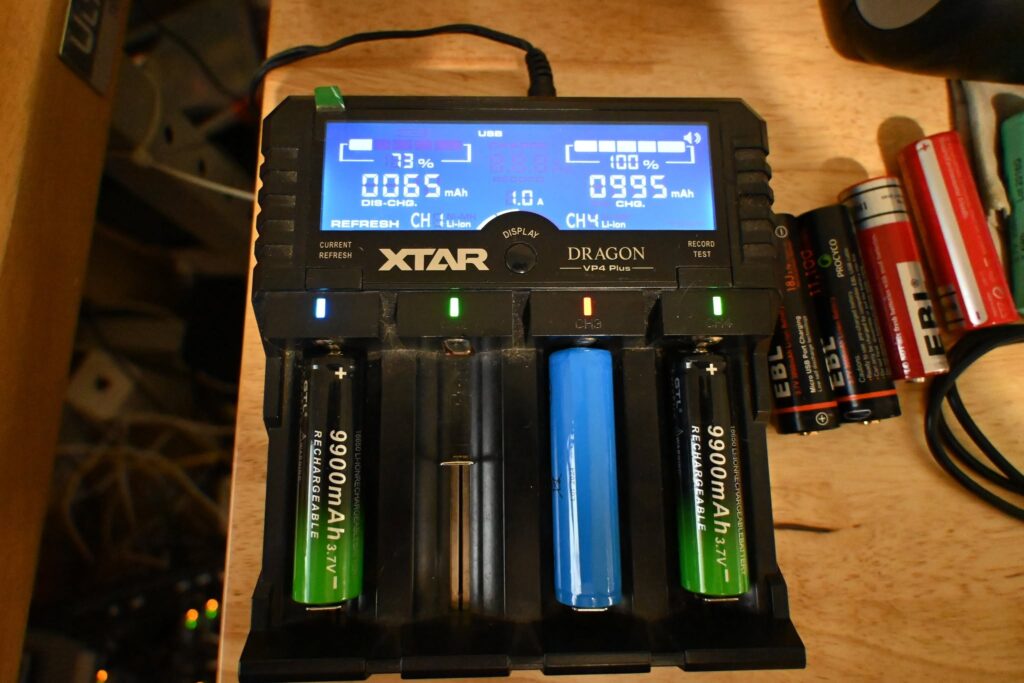
I want you to look at the green/black battery on the far right hand size. It is branded as a GTL Surefire I bought it and its brother on the far right hand side from Amazon. If you look at the LCD for Slot 4 (right hand side) you will see that after a complete discharge of the battery and full charge the battery reads just less than 1000 mAh.
I was a victim of deception here as the battery labels say they are 9900 mAh in capacity.
I bought the hype. Also, I was stupid.
The largest actual capacity 18650 that is not phony baloney is around 3600 mAh. This is your giveaway when manufactures claim crazy things.
The other GFL battery on the left in slot one is in a discharge cycle. You’ll have to take my word for it but after it completed its cycle it also came in at just barely over 1000 mAh. Junk. The internet says not only are they deceptive but they are also dangerous and a fire hazard.
Unmarked Blue Battery
This is the funny part of this story. The blue battery is an OEM battery that I received in a short wave radio that I purchased SEVERAL YEARS AGO. The battery label says that it is a 2500 mAh battery.
I also drained and charge Mr Blue here and after completing its cycle it read 2613 mAh. Or more capacity than claimed. One would think that the OEM battery would be junk and buying a higher capacity battery on the interwebs would be a smart move. NOT ALWAYS.
Milli Watt Hours (mWh)
I have a battery that claims to be 11000 mWh in capacity. Let’s test that claim. But first, some math.
To convert mWh to mAh you take the capacity divided by the voltage.
11,000 ➗3.7 = 2972.97 mAh
Now when I actually tested that battery it came in around 2650 mAh. That is close to advertised capacity but does still fall short of claims. I had two batteries and they both had the same numbers effectively.
Internal Resistance
For Li-Ion batteries this is an expected result for testing. I should add that some batteries may have an internal battery management system (BMS) in them that may reflect in a slightly higher internal resistance.
Measurements are recorded in milliohms (mΩ).
1 mΩ = 0.001 Ω (one-thousandth of an ohm)
Li-Ion Internal Resistance Reference Chart
| Cell Type / Category | New / Excellent | Good / Normal Aging | Degraded (High Sag) | End of Life / Unsafe |
|---|---|---|---|---|
| High-Drain 18650 / 21700 (Power tools, vapes, EVs) | 10 – 20 mΩ | 21 – 35 mΩ | 36 – 60 mΩ | > 60 mΩ |
| Standard / High-Capacity 18650 (Laptops, flashlights) | 25 – 45 mΩ | 46 – 75 mΩ | 76 – 120 mΩ | > 120 mΩ |
| Large Prismatic LiFePO4 (100Ah+ solar/marine cells) | 0.2 – 0.8 mΩ | 0.9 – 1.5 mΩ | 1.6 – 3.0 mΩ | > 3.0 mΩ |
| RC LiPo Pouch Packs (Per single cell, 2000–5000mAh) | 1.5 – 5 mΩ | 6 – 12 mΩ | 13 – 20 mΩ | > 20 mΩ |
| Small Consumer Pouch (Smartphones, wearables) | 80 – 150 mΩ | 151 – 250 mΩ | 251 – 400 mΩ | > 400 mΩ |
My two 11,000 mWh batteries both measured around 33 and 35 mΩ of resistance. The batteries in the photo in the first paragraph of this blog had an internal resistance around 42 mΩ. That battery contains a small battery management system (BMS) and those readings were considered normal and perfectly okay.
There is a lot to this battery testing stuff, huh?
Testing Instrumentation
You may have clued in by now that I have a couple of battery testing devices. I also have a couple more inbound.
There is an old saying that goes like this: “Verify the instrument before condemning the specimen”.
In other words perform your tests on calibrated equipment and even better, perform your tests on two separate pieces of equipment.
In the end we want solid and accurate measurements which are really only obtained by a 4 wire Kelvin tester. We test for:
- Voltage
- Capacity (mAh)
- Internal resistance (mΩ)
Final Thoughts
While I focused mostly on 18650 batteries which are common in high powered flashlights and radios much of this applies to rechargeable batteries of common sizes.
Christmas is sneaking up on us again and many parental units will buy a bunch of batteries to be ready for toy assembly operations.
And if you think you love the environment and use rechargeable batteries, ensure they are from trusted sources and not from Jimbo’s Battery Discount Store on the internet.
There are bold faced lies regarding battery capacity and even dangerous batteries are out there. You may not need an internal resistance tester or fancy battery chargers but trust the reviews of those of us who do have them.
If you know you need to order batteries or buy them at the store take a couple of minutes and google reviews for that brand of battery. Trust me. If I would have googled “GFL Surefire” I’d have never ordered them. I think Surefire = Certainty of a fire. Sure fire.
Be smart, and be safe.