
Coospo TR70 Smart Radar Tail Light Review
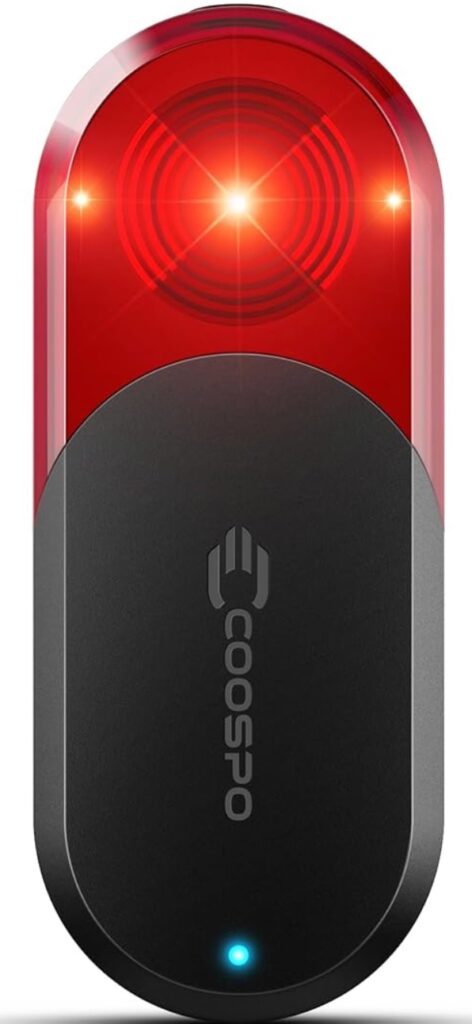
I recently purchased a Coospo CS600 bicycle computer which I reviewed here. Additionally I blogged about creating custom maps and took that discussion over to Reddit. Somewhere along the line Coospo contacted me and asked me if I would review their Coospo TR70 Smart Radar Tail Light. Yes. Please.
Before I received it I did all the requisite homework such as reading the manual, reviewing the FCC ID Reports and by reading and watching tons of reviews.
While there are certainly much better bicycle reviewers than me that doesn’t necessarily mean there are riders with a better understanding of active and passive radar systems than me.
In fact I was a little bit (a lot bit) disturbed by some of the reviews which really had not much technical merit to them at all.
Some reviewers seem to think that because the Coospo TR70 is inexpensive that surely it is inferior to more expensive offerings. That’s not how you review a safety item.
I think I should first boldly state that:
“Having a bicycle radar should never stop you, not even once, from looking over your shoulder.“
My Background And Qualifications
Early on in my working career I worked for a US Government Aviation Engineering Command called Naval Aviation Engineering Service Unit (NAESU). I was assigned to the Materials Science program. One of the programs I was signed into was a Confidential Program called Radar Absorbent Materials (RAM). It was classified back then but these days it is all on the internet.
Anyway, the program was designed to reduce the Radar Cross Section (RCS) of the F/A-18 aircraft by utilizing RAM (paint, sealants, etc.) a considerable portion of that training was understanding the basic principles of radar operation.
Am I an expert on Radar? Absolutely not. But I dare say I have more training on the subject matter than most bicycle reviewers.
Design And Engineering
Knowing the exact design and engineering trade offs here is tricky because most manufacturers request confidentiality of some design elements in the FCC ID reports. Coospo is no exception here. So I’ll try to keep this focused on what I do know from the reports and basic radar design parameters. Even if you are lucky enough to see internal photos, many times the chip markings are purposely obscured or redacted.
If an engineer were to design a device to detect vehicles behind you believe me when I tell you that there are multiple means to the same end. There are a variety of ways to accomplish this. Two examples are:
- Coverage-Optimized mmWave Sensor – Prioritizes an object that is approaching
- Resolution-Optimized Radar – Can distinguish between closely spaced objects
The Coospo TR70 is a Coverage-Optimized Radar. Additionally, it operates around 24 GHz with an occupied bandwidth of 31.114 MHz. Horizontal coverage is 40°. The Modulation Type is FMCW. Detection range is about 140 meters.
There are an awful lot of trade-offs which you can use to accomplish this, or to make one aspect of the radar detection better to the detriment of some other element.
One obvious way is the antenna which is used. The Coospo uses a 12 element millimeter wave patch array antenna. The big name competitor uses an 8 element patch antenna. Does this make the Coospo Antenna better? I can’t answer that as there are so many trade-offs in antenna design as to be impossible for me to understand.
Some of those trade-offs could be:
- Component cost and availability
- Overall design parameters
- Are you shooting for a uniform beam pattern or better detection?
- Suppression design for reducing false targets
- Is this designed for heavy traffic around many tall buildings?
I could go on and on and on.
False Targets
All of these bicycle radars are going to have the occasional false target. It is going to happen. And of lot of it depends on your riding environment and your installation.
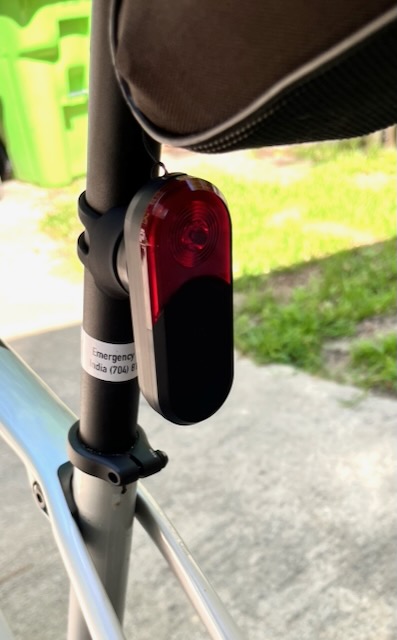
You can get a bounce off of a variety of objects such as buildings, guardrails, roadsigns, and quite possibly the biggest offender could be improper installation angle or whether there are obstructions on your bike such as a bike bag.
Making sure the radar is as vertical and perpendicular to the road is vital to its ability to function as intended.
A clean, unobstructed view of the road is equally as vital to its correct functionality.
One of my bikes has a large bag on the rear rack and while it looks like it has a clear shot you have to remember this radar has about a 35° Vertical Coverage.
Reflections are a problem in many riding environments. My typical out and back is in the Croatan National Forest in Eastern North Carolina. It’s not uncommon for me to ride out 11 miles and then back the same 11 miles and only see 15 or 20 cars. And that is on a busy day. There are no streetlights, only one or two guardrails on bridges over the streams and nothing but farms and residential homes.
That being said I have seen the occasional ghost detection on another manufacturers bike radar but mostly when I have opposing traffic and then mostly only when I am turning.
No bike radar is perfect and they will all produce false detections. The more congested (traffic, buildings, etc.) your route the more instances of false detections you will see.
I said this earlier and I’ll say it again:
“Having a clean radar screen should NEVER stop you from looking over your shoulder or in your mirror if you have one. “
People around where I live are nice. Rather than squeeze you out when there is opposing traffic, they will slow to match your pace and then pass you when the coast is clear. When they are behind you going the same speed that target can and does disappear in most instances.
Coospo TR70
Installation
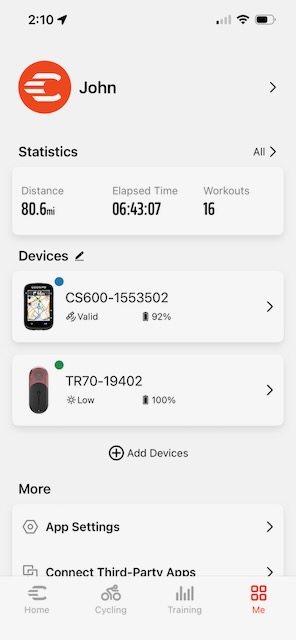
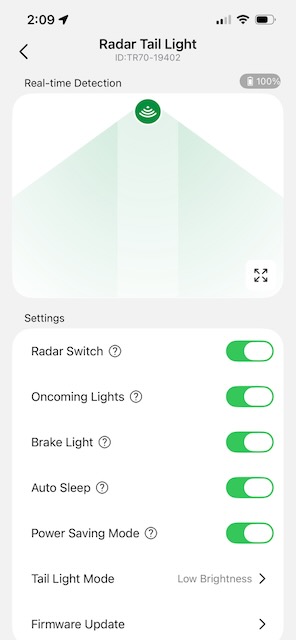
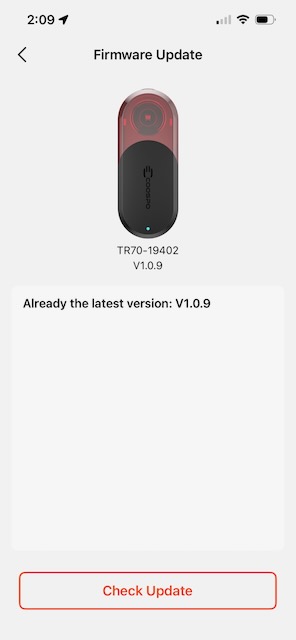
First thing. Charge it all the way up. Then you can add the TR70 within the CoospoRide app by selecting “Add Devices”. Then when tapping on the device you can configure the radar to your desired settings. Also at the bottom be sure to check and update your firmware as needed.
Click pics to enlarge
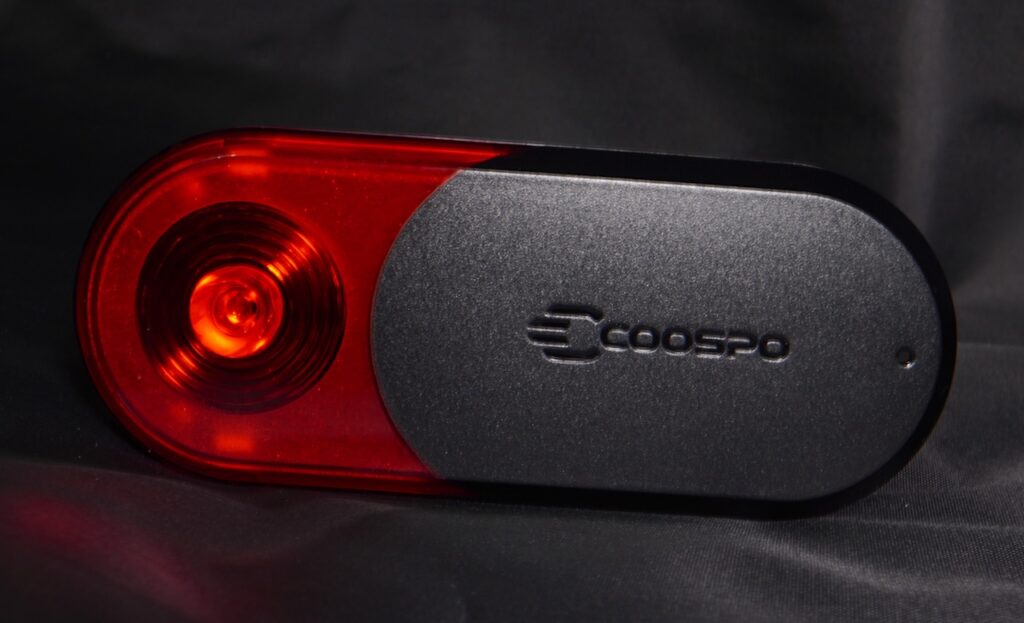
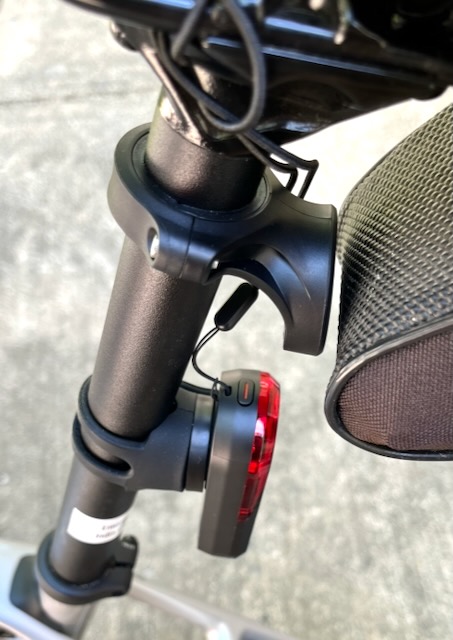
The Coospo TR70 won’t work on a standard 1/4 turn bracket so at least initially you need to use the mount that comes with the radar. I am not a fan of the “pull the rubber strap tight” mounts but that’s where the lanyard hole comes into play. You won’t lose your radar if the mount fails.
Mea Culpa
I own a Garmin RTL515. I am not going to do a comparison between the Coospo TR70 and the Garmin. Having said that I can state unequivocally that both are Frequency Modulated Continuous Wave (FMCW), 24 GHz millimeter wave sensor types. Each has similar bandwidth. Both use Printed Circuit Board (PCB) phase array antennas. And each claim the same range and horizontal coverage. If there is a gigantic difference anywhere, and I am not saying there is, it will be in the firmware or light configuration.
But I will say one thing the Coospo has all over the Garmin. This may seem small but there is a place to install a lanyard loop to secure the radar to your bike. Who wants something that costs that much money to just be able to fall off? Attaboy Coospo. It’s simple but it is oh so important. (photo in previous paragraph).
I know what some of you are thinking. They make silicone sleeves for the RTL515 that has a lanyard loop. I have one of those as well. I’m convinced that if the radar falls off it will safely hold the silicone sleeve in place while still dropping the radar. My wife watched me put it together and even she thought it wasn’t secure. Lots of Amazon reviewers say the same thing.
So to me the lanyard loop hole in the TR70 is huge.
Anyway, my takeaway here is that both radars are very similar.
SETUP
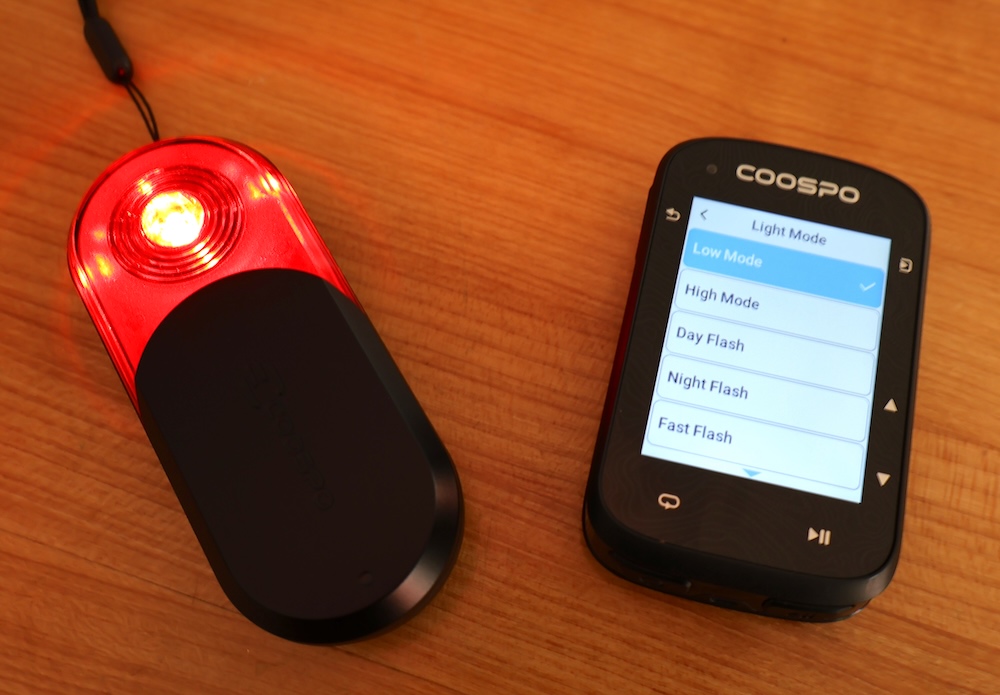
Once the light is paired to your bike computer you can also adjust your settings right on the computer screen.
For now I’ll leave mine at the defaults as I get deeper into the review. My rides are pretty much mirror images of each other
Here is something I noticed. When pairing with the Coospo CS600 bike computer you can switch the side the vehicle bar is on by going to Setting → Ride Mode → Outdoor (ON) → Fields → Radar → Vehicle Column
Initially, I thought you couldn’t do it. I looked around and failed but Coospo let me know where to find it. Thanks!
Installation angle is critical and it should be as vertical to the ground as possible. Additionally, it should not be obstructed by fenders or bike bags, etc.
Where I Need Radar The Most
But by and far the most dangerous place on my ride is turning left into my driveway at the end of the ride . I live on a nasty curve and there are memorial crosses right across the street from my front yard.
Not only do people close in on me fast, the window of opportunity for making that left turn is slim as cars scream around that curve in both directions. Heavy foliage prevents a good long look around the curve in front of me. This means I really have to worry what is behind me. If anything is approaching me from behind my strategy is “ABORT”. I pull off on the shoulder and stop. If I can’t make that turn and I have to stop in the middle of the road I’m as good as dead if someone is right behind me. If not from the car behind me, then from the one coming up behind them. It is really a sticky spot.
To make it worse there is a slight hill before my driveway and my turn is on the descent of that bump. Cars appear out of nowhere behind me because of that road profile. That gives them less time to react to a bicycle rider stopped in the middle of the road on a nasty, dangerous curve.
And it clearly demonstrates how a functioning radar can help me make the split second decision as to whether to stop in the road and wait, or peel off to the shoulder and stop there. And this is where the vertical coverage of 35° is critical.
I have never been confident in making this turn. Having a radar that I trust really eases the anxiety of this dangerous situation.
Compare any radar at any price point to this one but it really narrows down to “do you trust this radar?” And I very much do trust the Coospo TR70, especially in this situation.
Inaugural Ride
I tried to pull my camera out of its mount and video when a car was approaching. After reviewing the video I determined that it was unwatchable. Stopping your bike on the side of the road to video the screen isn’t representative of actual conditions either.
1st Ride
Here is what happened.
I rode 22 miles with the radar on. I had ZERO false detections.
On one occasion a car matched my speed right behind me and wouldn’t pass me due to approaching traffic (Thank You) and they disappeared from radar for a few seconds. As soon as they accelerated they popped back on the screen and were right on me when it reappeared. That is a known condition of all of these bike radars.
2nd Ride
Perfect ride and the radar gave no false indications.
3rd Ride & Subsequent Rides
Had a couple of cars disappear after being acquired by the radar. A quick head turn confirmed that both cars had turned onto side rides confirming accurate functioning of the radar.
I walk with a friend of mine who lives a couple miles from me. I observed no anomalies during any of these subsequent, short rides.
What Is My Honest Opinion Of The Coospo TR70 Radar?
Honestly, I trust it. Bike radars are cool. But they are no substitute for using your ears, eyes, and common sense. They are a value added tool. Nothing more, nothing less.
Similar bicycle radars are also 24 GHz with similar coverage and similar PCB mm wave sensor phase array antennas. Does one work better than the other? That’s really a tough question to answer unless you own a test laboratory.
As I indicated before I have the Garmin offering and I have to say in my riding conditions I don’t consider one to be better than the other.
“UNTIL YOU FACTOR IN THAT THE COOSPO TR70 LITERALLY COSTS 50% LESS. THAT’S BETTER, HUH?”
I can’t say that the Coospo TR70 is an amazing device in downtown Manhattan without riding in downtown Manhattan. But I can say that riding with it in the Croatan National Forest on Eastern NC country roads provides a very trustworthy experience. I trust this radar to make my dangerous left hand turn into my driveway with my life. I can make a far more informed decision on what to do with the radar as opposed to just turning my head. Here’s a video on what a driver behind me might see:
Yikes! If you watched that video you can see my situation and it probably is worse than I made it out to be. It stinks that the most dangerous part of my ride is the turn into my own driveway at the end.
I have to reiterate though that the TR70 picks up on approaching vehicles way giving me more than enough time to decide if I pull off the road and wait out the traffic or if I just keep going straight past my driveway or if I can negotiate a perfectly safe turn.
I approach this situation with a lot more confidence than I did prior to using a bike radar.
In conclusion, the radar specs are similar to the bigger brand names. Maybe better. Firmware, software, and things like app configurability could result in one being better than the other. But as far as radar detection criteria goes, John’s Tech Blog says, “Save yourself some money”. Oh and pair this with the Coospo CS600 Bicycle computer which is a giant killer. Give Coospo a little time with some software and ecosystem development and they may very well be your new favorite. I’m basically already there.
I was very intersted in this review, it was very informative and l think quite balanced in praise & criticism – altho very little criticism – but l know this review is/was primarily on the radar feature, but l think another feature worth mentioning is the “braking light” feature which activates when slowing down, this must help on that dangerous left-hand turn to home?