Category Archives: Networking

Networking

Metronet Static IP On OPNSense

Metronet Static IP On OPNSense

As luck would have it, fiber internet has made its way to our house out in the boonies.  Most cable/internet companies charge an arm and a leg for a static IP and call it a “business account”.  When the sales rep came by I asked how much a Metronet Static IP cost.  The reply was $10 a month.   I was sold on that for sure.

Otherwise, Metronet uses Carrier Grade Network Address Translation (CGNAT) for IP addresses.  What that means is that your router or firewall will pull one address, but that your actual IP address is something else.

What that really means is connecting back to your home network via VPN can be a lot more complex.  Also, Murphy’s VPN Law, states that you will pull a new DHCP address only while you are away on vacation rendering your ability to connect to your network null and void.
Continue reading
QNAP NAS Review TS-433-4G-US

QNAP NAS Review TS-433-4G-US

I’ve never bought an off the shelf NAS before and have always opted to build them on my own.  There is no better resource for NAS building than this website.  I currently have two home brew NAS’s in operation but had a need for a 2.5 GB NAS for a new, faster network I was setting up.  I settled on a QNAP NAS for a couple of reasons.

Reason number 1 was that initially my 2.5 GB network was only going to be in the downstairs part of my home.  Reason 2 is because since it was downstairs it needed to be somewhat attractive to appease my wife, and something somewhat quieter than my home brew NAS builds.

QNAP NAS

QNAP NAS

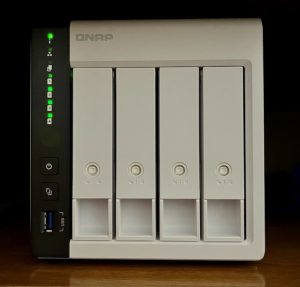
After a considerable amount of research I opted to get the QNAP TS-433-4G-US.($379)

4 bays is enough for me I have four 4TB Western Digital Red drives in a RAID 5 array.

This NAS is simply for file storage and I won’t be asking it to run any media servers or anything else that might overtask it.

I have a super NAS upstairs with a Xeon processor and tons of RAM and storage with Unraid as the OS.   It does all that heavy lifting.

I do use the QNAP for Apple Time Machine backups for several Macs I have in the house.

I also run another server which is located in my back yard shed which is a Raspberry Pi Compute Module 4 with a SATA PCIe controller and a couple of 6TB hard drives.   It runs OpenMediaVault (OMV).

This will NOT be a technical review.  No specs, no stats.  Just me talking about whether buying a NAS off the shelf is something a NAS user would want to do or not. 
Continue reading

Mokerlink Review 2.5G Managed Switch

Mokerlink Review Of 2.5G L2 Managed Switch

Mokerlink Review

Mokerlink L2 Managed

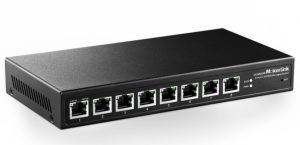
When upgrading your home or small business network you will quickly discover that 2.5G switches are not cheap.   Today I do a Mokerlink Review of their 8 port, managed 2.5G switch.

I ordered the switch from Amazon at a cost of $175.  While that might be inexpensive for a 2.5G switch it isn’t inexpensive for a network switch.  It will definitely make you question whether upgrading your network to 2.5G is worth it.   I understand that a 2.5G switch is going to be more expensive than a 1G switch but there is a huge chasm in pricing between the two.

First Impression

The first thing I noticed wasn’t about the actual switch.  As soon as I buy something I head to the internet to download the manuals for it.  When I went to the Mokerlink website their https certificate was expired and my browser was telling me it might not be safe.   The next day I tried and the website was down.  This morning, I finally was able to get to their website and download the manuals.

So my first impression is not a good one.  Someone is not minding the store at Mokerlink and keeping track of their web host.   Heck, at John’s Tech blog and my other web site I get a ton of emails from my host months in advance of an expiration of a domain name or a certificate.
Continue reading

WiFi Connection Issues

WiFi Connection Issues Fix

I’ve always been the neighborhood geek and I have done this simple wifi connection setting for so many people.  Let me set the scenario up for you.  I’ll get a call or see a post that says “My internet provider is crap.  My WiFi disconnects all the time.  Don’t get _____________ for your internet provider.  We hate them.”

Your Wifi Router

Most people think when you connect to your home wifi you’re connecting to 1 choice.  In reality there are 2 choices usually.

  • 2.4 GHz wifi network
  • 5 GHz wifi network

2.4 GHz is usually the most common connection made and it has the best range.  It consists of 11 channels in the US.  Each one of those 11 channels is selectable or most routers are set to obtain the channel automatically.

5 GHz is not utilized as much as a lot of people just don’t know about it.  Of the two wifi’s, 5GHz provides a faster connection albeit over a shorter range.  It consists of 24 channels.  Whenever possible you should try to utilize your 5 GHz connection.

The rabbit hole goes a little deeper than just the number of available channels but for now, this is all we really need to know.
Continue reading

Tasmota Light Bulb Kauf A21

Tasmota Light Bulb Kauf A21

Tasmota Light

Kauf A21

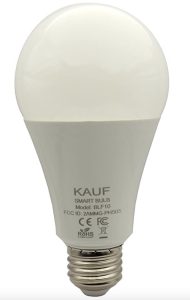
There are a ton of smart Internet of Things (IoT) devices out there.  Most of them are a security nightmare to introduce into your home network.   But I’ve found one that ISN’T a security nightmare.  The Kauf A21 bulb with ESPHome Firmware is one such device.  An ESPHome or Tasmota Light will ONLY communicate within your home network.  A Tasmota Light is my personal preference for home automation.

These lights are designed to work with home automation software such as Home Assistant

If you buy a light bulb at Walmart you can control it with an app you put on your phone.  And while that seems cool, it really isn’t. That app, and that bulb communicate off of your phone and contact servers outside of your home network.

IoT devices that are app controlled are a security risk.  And in your quest to smarten up your home you may have several devices and several apps. Additionally,  those apps want you to grant permission to use your camera (presumably to scan a QR code) and they also want location control enabled.   Why does my Lifx bulb I bought at Walmart need to know where I and my phone are?  Riddle me that, Batman.
Continue reading

Network Server Apps

Network Server Apps

So you’ve either built or bought a network server.  Maybe it’s a Synology or QNAP NAS.  Maybe you made a server with Unraid,  TrueNAS or OpenMediaVault.  Or maybe it is something else.  No matter what you have, you have the ability to add network server apps.

But I want to give you a thing or two to think about before you add those cool applications.

There is no doubt that adding functionality to your server is powerful, and can be very cool.  But is it ALWAYS a good idea?  I’d like to tell you a story about two apps that I thought were brilliant but then created some issues for me later on.  Bear in mind this is just two apps, and your mileage may vary.  I just want to give you something to think about.
Continue reading

Mikrotik SolidRack 10

Mikrotik SolidRack 10

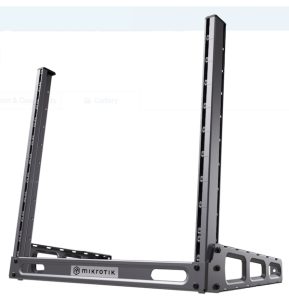
I recently went through a round of network upgrades and I had stuff and cables all over the place.  There was a real need to get organized and to employ at least a LITTLE cable management. I also decided to run two separate networks and needed a simple way to keep everything straight.  Enter the Mikrotik SolidRack 10.

Mikrotik SolidRack 10

SolidRack 10

Most server racks are either big, or expensive, or both.  I didn’t want anything big.  Just a place to mount a couple of switches that didn’t occupy too much real estate.

That is where the Mikrotik SolidRack 10 really shines.  It is small, and very affordable at about $43 at Multilink.  Right this second they are out of stock.

I do want to point out the obvious with this rack.  There are no back legs!  That is NOT a complaint.  All I’m saying is this is for light duty use and you aren’t going to cram some Dell PowerEdge servers in this thing.

Okay, I will concede that you probably could do it if you hacked something up or propped up the back end of the server with a ServerBrick™ or something.  But natively, it’s not meant for that and you know what I meant.
Continue reading

Home Networking Upgrades

Home Networking Upgrades

This has been a lot of years coming.   I’m certainly no home networking guru or sys admin, but I’ve always been a step or three ahead of the common home network setup.  I have about 65 Internet of Things (IoT) devices and home automation.  In my mind “automation” is the operative word.  Push my doorbell, I get a text.  Garage door opens, I get a text.  Motion happens in an empty house, I get a text.  Lights come on at sunset.  .

You need a fairly robust network backing all this hardware up and MOST IMPORTANTLY you need to segregate all those IoT devices from the computers that hold your precious, personal, private data.   I bought a cheap outlet to tie into my home automation.  The person that did the initial hack claimed the device was transmitting data back to some server in China.  Just for fun before I hacked the outlet I put it on the network and began watching the data packets flow to and from the device.  Sure enough, it was communicating with a computer somewhere in China.  I’m sorry, but no device in my home should be communicating with a computer offshore, unless I tell it to.

Your cameras, your IoT devices, and your other internet enabled toys should not be on the same network as your personal data.
Continue reading

Anker USB C to 2.5 Gbps Ethernet Adapter Review

Anker USB C to 2.5 Gbps Ethernet Adapter Review

I recently upgraded a segment of my home network to 2.5 GB ethernet.  I keep a huge folder on my laptop called “Archive” that has basically every manual for everything I own in it.  Also there’s other junk in there too.  It’s huge, and it takes forever to back up.  In the interest of backing everything up quicker once every week or so I decided to get a 2.5GB ethernet dongle to move those files to my snazzy 2.5GB NAS.  After a bit of research I settled on the Anker USB C to 2.5 Gbps Ethernet Adapter.

Anchor Arms

Sorry.  Every time I see the word “Anker” my mind wanders to the SpongeBob episode where he bought inflatable Anchor Arms.  The goal was to get ripped like Larry Lobster.

And such as it is with me and my network.  I’m trying to get ripped backing up that huge folder quickly somehow or another.

Continue reading

Netgear MS108EUP Review & VLAN Setup

Netgear MS108EUP Review

And Simple VLAN Setup

Netgear MS108EUP

2.5GB Netgear MS108EUP Router

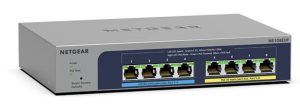
I just built a new firewall appliance that has four 2.5GB speed ports.  I attached it to a Mikrotek hap ax³ router which also has a 2.5GB port on it.  Then I added in a QNAP NAS which also has a 2.5GB port on it.  To hook them all up together I needed a fast switch and I settled on the Netgear MS108EUP.

You can find hardware with 2.5GP ports on it pretty easy.  But you know what is hard to find?  A 2.5GB network switch that doesn’t cost an arm and a leg.  Somehow or another hardware vendors are making devices with 2.5GB speeds.  Sadly there really aren’t that many switches out there to support the speed..  They went right from 1GB to 10 GB and skipped right over the middle ground.

And while you might be able to find some $100 switches, finding one that is Managed (Smart) is quite a bit trickier.  A managed switch is one that can do other tasks such as Virtual LAN’s (VLAN) among a lot of other tricks.   A VLAN can be used to segregate certain aspects of a network such as the establishment of a Guest Network that can’t communicate with the primary network.   Or keeping HR away from the Operations Department.   You get the drift.
Continue reading